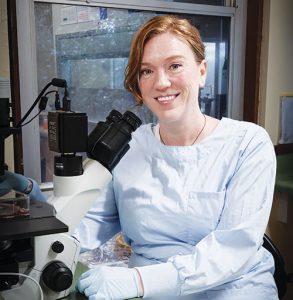
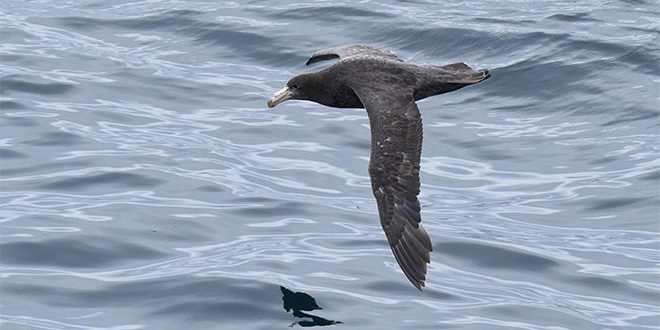
DOCTOR Lee Campbell is a comparative immunologist whose research investigates how Australian wildlife species respond to different pathogens. Her background includes research in avian immunology and avian influenza, including host responses to highly and low pathogenic avian influenza viruses. She is a postdoctoral research fellow in the Sydney School of Veterinary Science at the University of Sydney and has presented at the Australian Poultry Science Symposium. The following was written by Dr Campbell specifically for this publication.
After years of devastating poultry and wildlife populations across the globe, highly pathogenic avian influenza H5N1, clade 2.3.4.4b has officially arrived in Australia. The first detection was in a brown skua found near Esperance, Western Australia. At the time of writing, 27 detections in wild seabirds have been recorded across Australia. There have been no detections in poultry or Australia’s agricultural production system. Whether H5N1 becomes established in Australian wildlife remains to be seen.
For producers, the important question is whether these remain isolated cases, largely in migratory seabirds, or whether the virus begins circulating more widely in resident Australian birds. Everything the virus does before it reaches a commercial flock occurs first in wildlife (see Figure 1).
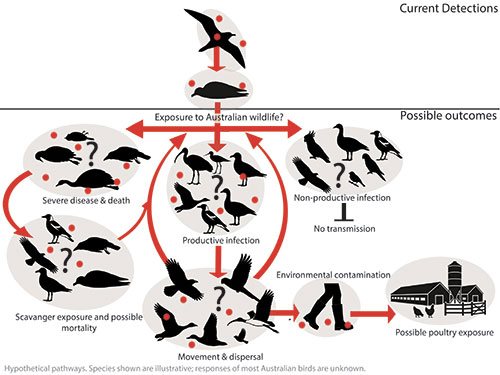
Figure 1. Possible pathways for H5N1 to move through Australian wildlife and reach poultry. The species shown are examples, as we do not yet know how Australian birds will respond.
Wildlife surveillance, additional immunological research and models of wild bird movements and behaviour in Australia could identify relevant risk factors before infection in a commercial flock becomes the first warning. Avian influenza viruses have circulated among wild birds for thousands of years and generally cause little disease in their natural hosts. So-called low pathogenic avian influenza viruses regularly circulate in wild birds, especially ducks and other waterfowl, including those in Australia and surveillance has given us a reasonable understanding of some of the species involved and the environments where these viruses occur.
This means this newly introduced strain is not entering an empty landscape. This distinction matters because influenza viruses are constantly changing. A defining characteristic of influenza viruses is their ability to evolve, including through a process called reassortment (see Figure 2).
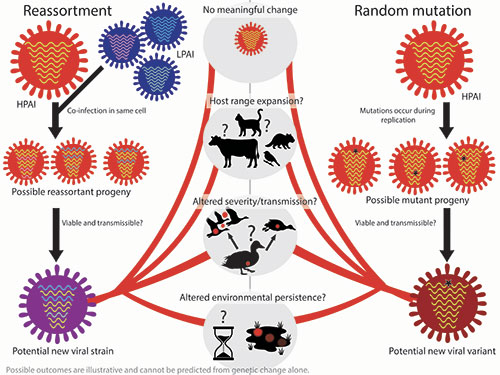
Figure 2. Avian influenza can change by reassorting with other strains or through random mutations. These changes may do nothing, or may alter which animals it infects, how it spreads, the disease it causes or how long it survives outside a host.
These viruses contain eight separate gene segments and, occasionally, when two or more viruses infect the same cell, they can swap these segments, creating new viral combinations. Australia already has endemic LPAI viruses circulating in wildlife, meaning H5N1 is entering an environment where interactions with local influenza viruses are biologically possible. Whether reassortment will occur in Australia, or what any resulting viruses would look like, cannot be predicted. Continued surveillance and sequencing will be needed to detect if it does.
Influenza viruses also accumulate mutations as they replicate, some of which can affect the species or tissues they infect (see Figure 2). Such changes may have helped the current strain expand into mammals, including scavengers, seals and dairy cattle. To survive and spread, viruses rely entirely on their hosts.
Which birds become infected, how sick they become, how far they move, which habitats they use and how often they encounter poultry all influence where the virus goes and how it spreads. Understanding the behaviour of wild birds is therefore essential for understanding the behaviour of the virus. Additionally, not all wildlife will respond the same way to being infected by this virus (see Figure 1). Some will get sick and die and will not be able to transmit the virus long distances.
In others, receptor differences or early immune responses may prevent the virus from establishing a successful infection or being transmitted. The species likely to have the greatest impact on spread are those that can be infected without developing severe illness. Because they remain mobile while shedding the virus, they may carry it over long distances and expose new hosts.
In other parts of the world, we know that many of the reservoir hosts of avian influenza virus are ducks, especially dabbling ducks. As many Australian duck and waterfowl species are distinct from those studied overseas and have followed separate evolutionary histories, we do not know absolutely which individual species here will be most likely to spread the virus. This is also why Australia should not assume H5N1 will behave exactly as it has elsewhere.
Much of what we currently know comes from Europe and North America, where bird communities, immune responses, migration patterns, climates and landscapes differ from those found here. Many migratory waterfowl species in North America and Europe do what is called ‘staging’. That is, flocks containing thousands of birds converge at the same time each year, share close quarters and by association their viruses, resulting in somewhat predictable patterns of spread as they migrate to and from their breeding and feeding grounds.
Australian waterfowl tend to operate on different migratory patterns. Many Australian waterfowl are nomadic, following rainfall rather than strict seasonal flyways, which may produce more sporadic patterns of movement and infection. For producers, this information provides advance warning. Knowing which species are infected, where and when they move and how they interact with poultry can refine risk assessments and better target biosecurity efforts.
The aim is to recognise when isolated wildlife detections have developed into a pathway towards poultry, rather than discovering that change through the first infected flock. The risk begins in wildlife but whether it reaches poultry depends heavily on the barriers maintained at the farm. Consistent biosecurity – including clean footwear, controlled access and protected feed and water – remains the most
effective defence.
Current steps for preventing, reporting and detecting HPAI
- Prevent poultry and wild birds from accessing the same feed and water
- Use water supplies protected from wild-bird contamination and appropriately treat surface water where it is used
- Review access controls for people, vehicles and equipment entering production areas
- Clean and disinfect poultry housing, equipment and vehicles regularly
- Monitor birds for sudden deaths, reduced feed or water intake, falling egg production, breathing difficulties or unusual neurological signs
- Do not touch sick or dead wild birds – immediately report unusual illness or deaths in wild birds or poultry to the 24-hour Emergency Animal Disease Hotline on 1800 675 888.
For more information, contact lee.campbell@sydney.edu.au
Dr Lee Campbell